Airbnb Check-in Inspection: Why One Report Is Never Enough
Free tool for thisDamage Documentation ScoreScore your whole documentation workflow and find the gaps that get claims denied.A checkout inspection without a check-in inspection is half the evidence. It is the half that loses claims.
You find damage after a guest leaves. You documented everything at checkout. Photos, timestamps, room by room. You file the claim feeling confident.
The guest responds with four words: "it was already there."
Airbnb looks at your checkout photos and asks a simple question: what did the property look like before this guest arrived? If you cannot answer that question with a verifiable record, the claim stalls. The guest's denial cannot be ruled out. The money stays with the guest.
Why checkout evidence alone is not enough
The pre-existing damage defence is the most common reason hosts lose disputes they should win. It is effective not because guests are right, but because hosts have no way to disprove it.
A checkout inspection shows the property after the guest. A check-in inspection shows the property before the guest. Only the combination of both creates a before-and-after record that closes the pre-existing damage argument entirely.
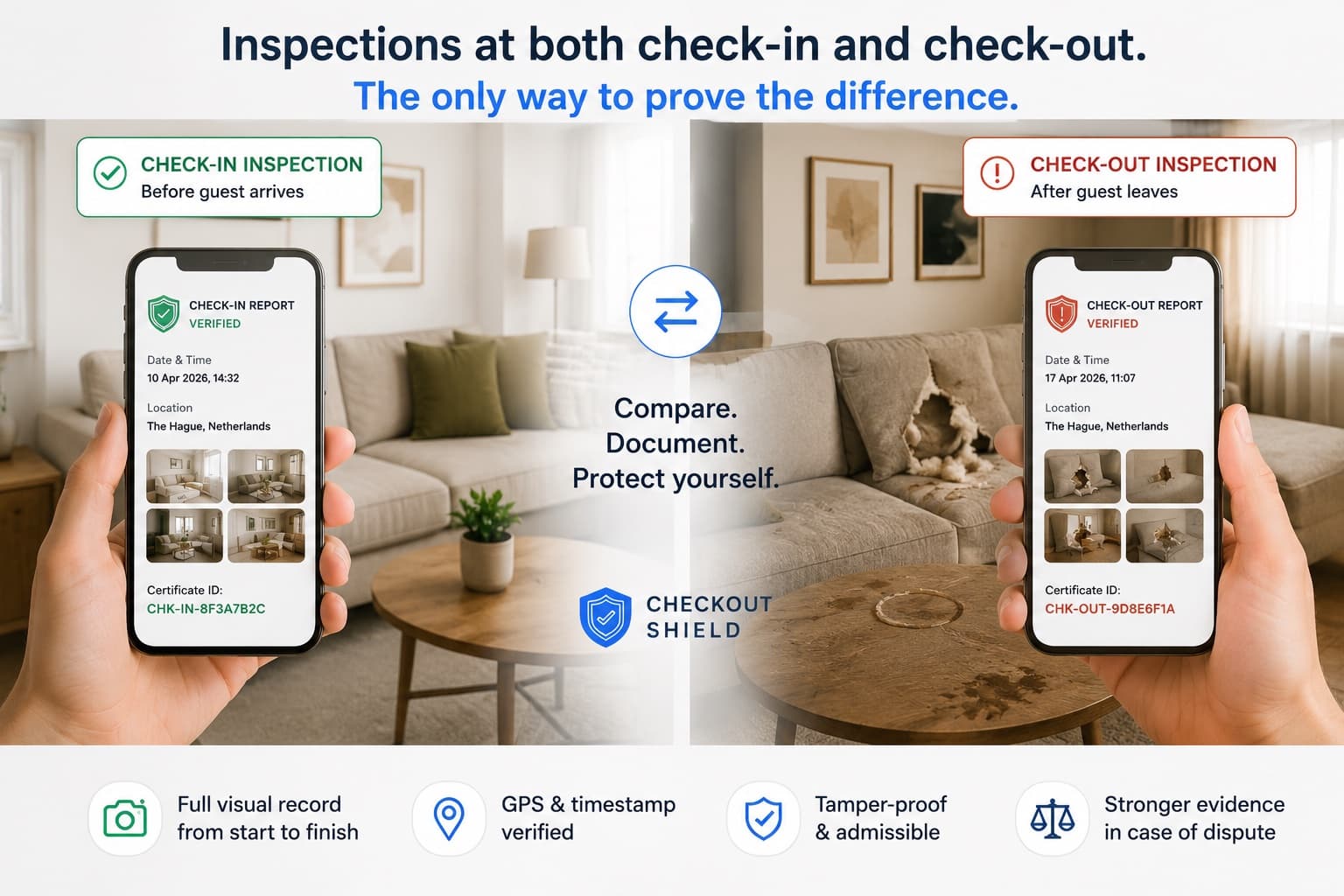
This is how it works. The check-in report documents the property in clean condition before the guest arrives, with a locked timestamp and GPS coordinates. The checkout report documents the same property after the guest leaves. The comparison between the two is the evidence that makes a claim undeniable.
Without the check-in half, you are filing a claim based on one side of the story.
What a proper Airbnb check-in inspection covers
A check-in inspection is not a deep clean report or a maintenance checklist. It is a condition record. The goal is to document the state of every area and item that a guest could reasonably damage, while the property is clean and before any guest interaction.
Room by room, focus on:
- Upholstered furniture: sofas, armchairs, mattresses, headboards. These are the most commonly damaged and the most expensive to replace.
- Hard surfaces: tables, countertops, floors, bathroom fixtures. Scratches and chips are easy to claim and easy to dispute without a baseline.
- Walls and doors: marks, scuffs, holes. These accumulate over time and become hard to attribute to a specific stay without documentation.
- Appliances and electronics: note any existing scratches or functional issues so a guest cannot claim something was broken on arrival.
- Outdoor areas: balconies, gardens, parking. Often overlooked and often damaged.
For each area, take multiple overlapping photos so the condition is unambiguous. One photo of a sofa is not enough. Three photos from different angles showing no damage is a record.
How check-in and checkout work together
The value of a check-in inspection is entirely tied to having a matching checkout inspection. A check-in report alone is useful but incomplete. A check-in report paired with a checkout report from the same property, using the same structure and the same verification standard, is a complete chain of evidence.
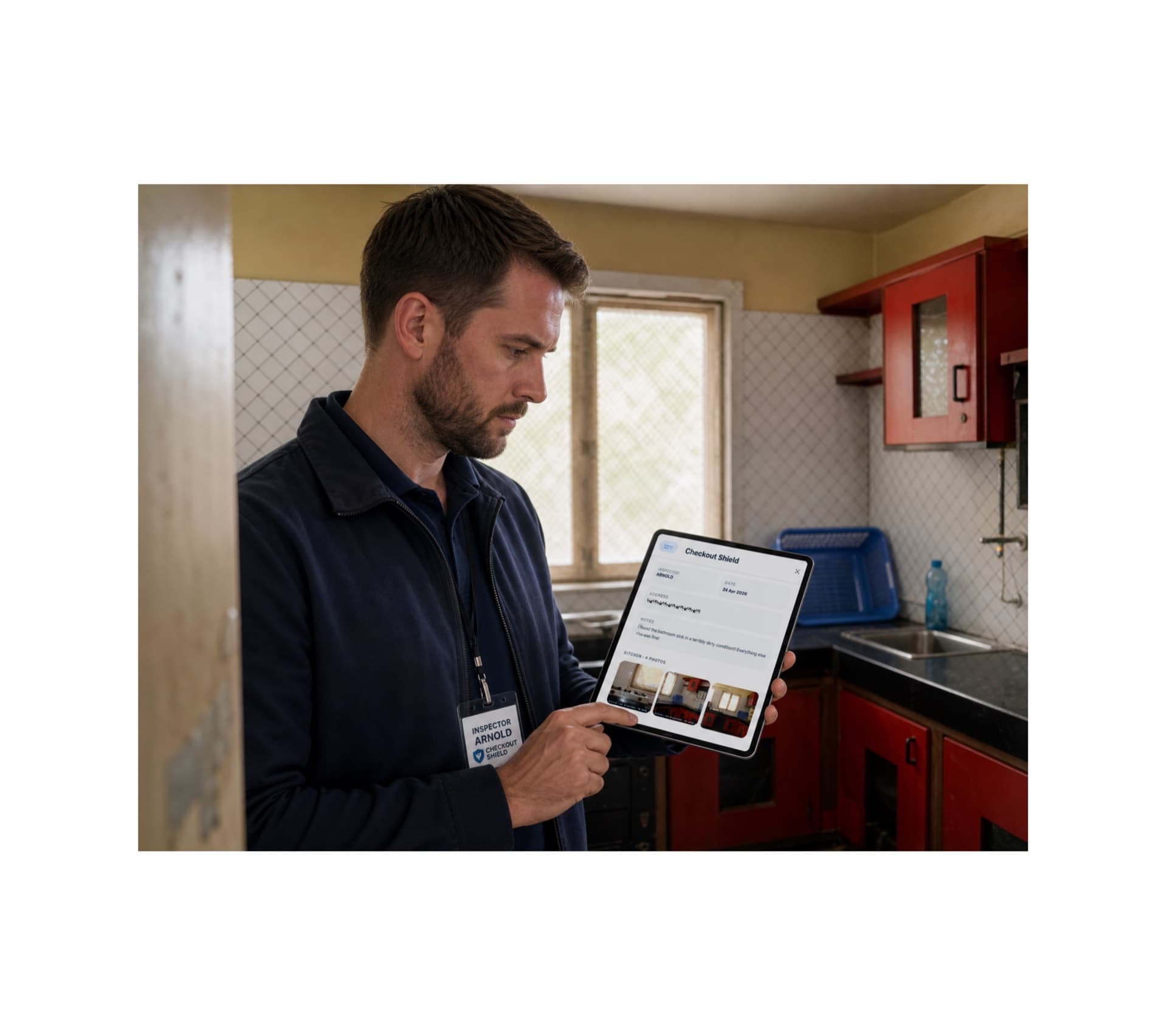
When both inspections use GPS verification and server-stamped timestamps, the comparison becomes independently verifiable. Airbnb reviewers, insurance adjusters, and even small claims courts can check the public verification link and confirm the data was not modified after the fact.
This is what makes the evidence useful in a dispute rather than just informative. It is not just you saying the property was clean before the guest arrived. It is a timestamped, GPS-locked record that says it, one that an independent reviewer can verify without taking your word for it.
Stop documenting damage. Start documenting condition.
Most hosts think about property documentation reactively. Something goes wrong, then they start gathering evidence. By then, the check-in window has closed and the pre-existing defence is already in play.
The shift that changes outcomes is treating documentation as a standard part of the turnover process, not a response to damage. A 10-minute check-in inspection completed before every guest creates a baseline that makes every future claim straightforward.
If nothing goes wrong, the inspection took 10 minutes and cost nothing. If something goes wrong, the inspection is the difference between a paid claim and a denied one.
Hosts who build this habit rarely lose disputes. Not because they have fewer difficult guests, but because they have eliminated the only defence that usually works: "it was already there."
What verified check-in reports look like in practice
Inspection platforms that generate GPS-verified, timestamped reports let hosts create a check-in record that can be linked directly to the matching checkout record. The comparison is built in. When a claim is filed, the before-and-after is already there, with a public verification link that neither the host nor the guest can alter.
The process runs in the browser on any device. Walk through the property, take photos in each room, and the report is sealed automatically with GPS coordinates and a server-side timestamp. No edits possible after creation.
For the full picture on what happens after damage is discovered, read what to do when a guest denies causing damage and how the 14-day claim deadline works. Not sure how much your current setup is costing you? The free Airbnb damage risk calculator estimates your annual exposure in 2 minutes.
The check-in inspection is where claims are won or lost
Checkout Shield creates GPS-verified, timestamped inspection reports at check-in and checkout. Both reports are linked, comparable, and independently verifiable. When a dispute comes up, the before-and-after is already sealed and ready.
Create Your First Verified Report, FreeFree tools for Airbnb hosts
Damage Documentation Score
Most hosts learn their documentation was weak only when a claim is denied. Score your whole workflow in three minutes, find the exact gaps that get claims rejected, and get a prioritized fix plan. Airbnb, Vrbo, and Booking.com.
Get my scoreAirbnb Risk Calculator
Estimate your annual exposure from denied claims and undocumented damage.
Calculate your riskAirCover Claim Strength Checker
Score your damage claim before you submit and see exactly what is missing.
Score my claimAirbnb Evidence Checklist Generator
Personalized evidence checklist by platform, host type, and property zones.
Generate my checklistGuest Damage Cost Estimator
See the real cost of a damage incident, including the part AirCover never repays.
Estimate my real costVA Incident Report Builder
Turn damage you found after checkout into a clear report the owner can act on.
Build the reportGuest Risk Pre-Screener
Score a booking request before you approve it, from behavioural facts only.
Screen this bookingOwner Monthly Statement Builder
Turn one property's month of numbers into a clean statement for the owner.
Build the statement