Airbnb Damage Claim Time Limit: How Long You Have and What Happens If You Miss It
Free tool for thisAirCover Claim Strength CheckerScore your damage claim before you submit and see exactly what is missing.You have 14 days to file an Airbnb damage claim. Most hosts lose money before they even realize this clock is running.
Here is how it usually goes. A guest checks out. You walk through the property an hour later and find damage. You take photos on your phone. You think you are covered because you have the evidence right there.
That is the mistake.
The photos show what the damage looks like. They do not show when it happened. And that single gap is the reason most Airbnb damage claims get rejected, not the deadline.
Why most claims fail before the deadline even matters
Airbnb does not reject claims because hosts are dishonest. They reject them because the evidence does not meet the standard required to override a guest's denial.
When a guest says "that damage was already there," Airbnb looks at your photos and asks one question: can you prove this happened during this stay? A regular phone photo cannot answer that question. The file metadata is editable, there is no GPS lock, and there is no independent verification of when the photo was taken.
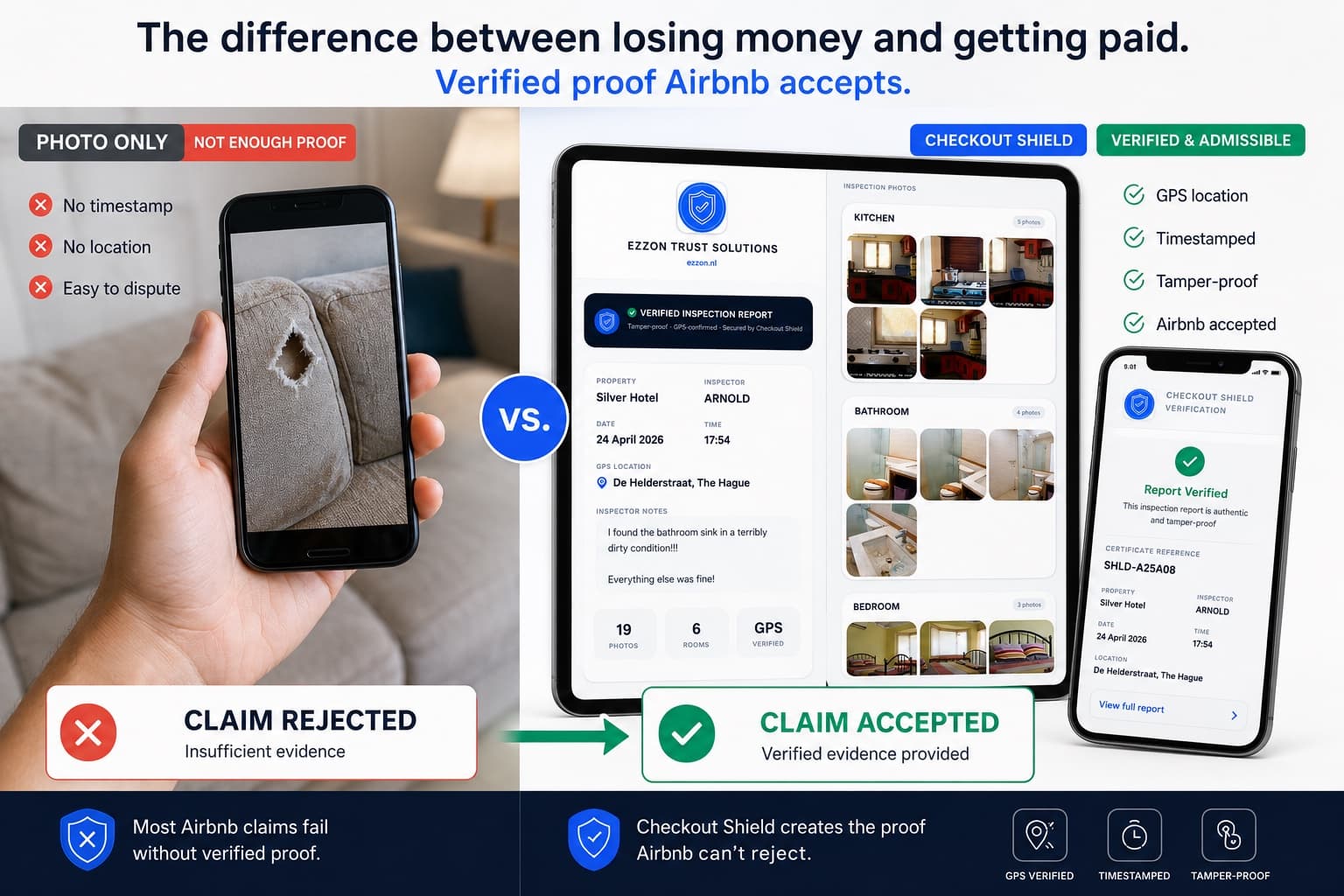
This is the difference. A regular photo gives Airbnb nothing to verify. A report with a locked GPS coordinate and a server-stamped timestamp gives them everything they need to rule out a pre-existing damage defence.
The 14-day deadline is real and you need to respect it. But hosts who focus only on the deadline and ignore the evidence problem are solving the wrong thing.
The 14-day rule and where it actually catches people
Airbnb requires you to submit a payment request to the guest within 14 days of checkout, or before the next guest checks in, whichever comes first.
That second condition is the trap. If you have a booking starting two days after checkout, your window is 48 hours, not 14 days. The moment a new guest arrives, the prior claim closes. No exceptions.
The clock also starts at the official checkout time, not when you discover the damage. If a guest checked out Monday and you do not inspect until Wednesday, you have already lost two days. Airbnb does not care when you found out. They count from checkout.
There is also a sequence you have to follow. You must attempt to resolve with the guest through the Resolution Centre first. Only after they decline or ignore the request can you escalate to AirCover. Both steps need to fit inside the same window. If you wait too long to start, you run out of time before the process is complete.
The difference between accepted and rejected claims
Hosts who consistently win damage claims are not luckier than the ones who lose. They document differently.
The hosts who lose file claims after damage appears. They take photos in the moment, submit what they have, and hope the evidence is enough. It usually is not, because the evidence only shows the current state. It cannot prove the before.
The hosts who win create a record before damage appears. They document the property at every checkout as a matter of routine, not as a reaction to finding a problem. When a dispute comes up, the before-and-after comparison is already there. The guest's denial has nothing to stand on.
The difference is not the damage. It is the baseline.
What verified evidence actually looks like
Some hosts now use inspection platforms that create GPS-verified, timestamped reports at every checkout. The report locks the location data and timestamp at the moment the photos are taken, stores everything server-side, and generates a public verification link that Airbnb reviewers can check independently.
This type of evidence is structured to answer the one question Airbnb always asks: can you prove this happened during this stay? When the check-in report shows no damage and the checkout report shows damage, both with locked timestamps and GPS coordinates, the answer is yes. There is nothing for a guest to dispute.
It also removes the time pressure from the equation. If your checkout inspection is already done and sealed the hour the guest leaves, you have the full 14 days to file a calm, complete claim. No rushing. No scrambling for evidence after the fact.
For more on what makes evidence strong enough to win, read the AirCover evidence checklist and why Airbnb rejects regular photos. To see what a missed claim could cost you annually, use the free Airbnb damage risk calculator.
The next claim starts at your next checkout
Checkout Shield creates a GPS-verified, timestamped inspection report the moment a guest leaves. If a dispute comes up, the evidence is already sealed and ready. No rushing the deadline. No hoping the photos are enough.
Create Your First Verified Report, FreeFree tools for Airbnb hosts
AirCover Claim Strength Checker
Score your AirCover damage claim in two minutes and see exactly what is missing from your evidence before you submit. Includes 14-day window awareness and a printable claim document you can attach to your AirCover filing.
Score my claimAirbnb Risk Calculator
Estimate your annual exposure from denied claims and undocumented damage.
Calculate your riskAirbnb Evidence Checklist Generator
Personalized evidence checklist by platform, host type, and property zones.
Generate my checklistDamage Documentation Score
Score your whole documentation workflow and find the gaps that get claims denied.
Get my scoreGuest Damage Cost Estimator
See the real cost of a damage incident, including the part AirCover never repays.
Estimate my real costVA Incident Report Builder
Turn damage you found after checkout into a clear report the owner can act on.
Build the reportGuest Risk Pre-Screener
Score a booking request before you approve it, from behavioural facts only.
Screen this bookingOwner Monthly Statement Builder
Turn one property's month of numbers into a clean statement for the owner.
Build the statement